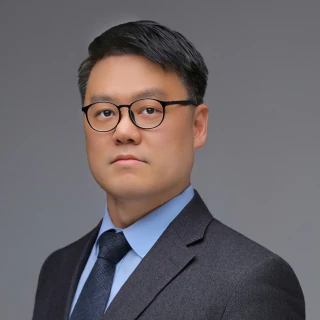
Junghwan Park is Director of the Division of Health AI and Data Policy at Korea's Ministry of Health and Welfare. Since 2026, his responsibilities have included ministerial oversight of the National Integrated Bio Big Data Project, alongside medical AI strategy and services, health-data infrastructure and governance, standards, and research. Across his public-service career, he has moved from national social-security systems through health-information infrastructure and biohealth innovation to AI-enabled care. He has served as Chair of the APEC Health Working Group since August 2026 and led the ministry team behind Korea's AI Basic Health Strategy. He earned his PhD in public health at UC San Diego, where he built just-in-time adaptive interventions using machine learning and control engineering. He also designs and ships practical AI and agent systems.
2020–2024 PhD, Public Health (Health Behavior) — UC San Diego / San Diego State University Advisor: Eric Hekler. Dissertation: Optimizing Adaptive Interventions for Physical Activity.
2002–2011 BS, Bio and Brain Engineering (Bioinformatics) — Korea Advanced Institute of Science and Technology (KAIST)
2026– Junghwan Park was appointed director of the Ministry of Health and Welfare's healthcare-data division in February 2026; it was renamed the Division of Health AI and Data Policy in July as its mandate expanded. His portfolio links strategy to delivery: AI-enabled primary and public care, real-world testing and data access for medical AI, secure research environments, data standards and governance, and the National Integrated Bio Big Data Project. The through-line is implementation — moving useful AI and data from individual hospitals and pilots into shared national infrastructure.
2026– Junghwan Park helped plan Korea's national bio big-data initiative earlier in his career and, since 2026, has held ministerial oversight of the realized National Integrated Bio Big Data Project as Director of Health AI and Data Policy. The four-agency program is building a consent-based resource linking genomic, clinical, omics, and public data. After start-up delays, reported recruitment passed 100,000 in late 2025; nationwide recruitment continues in 2026 while the project prepares its first staged research-data opening. The first phase targets 772,000 participants by 2028 and the second a cumulative one million by 2032.
2025– Since August 2026, Junghwan Park has served as Chair of the APEC Health Working Group, which brings the region's health officials together on health security, resilient health systems, digital health, and universal health coverage. The appointment follows his leadership of the Planning Team for the 15th APEC High-Level Meeting on Health and the Economy in Seoul in 2025. He organized the health track at the third Senior Officials' Meeting and steered negotiation of the Joint Ministerial Statement adopted by participating APEC economies, linking Korea's host-year delivery to an ongoing regional health-diplomacy role.
2026– Korea formally adopted the whole-of-government AI Basic Health Strategy on 6 August 2026 to use AI to close gaps in regional, essential, and public healthcare. Junghwan Park led the ministry team of policy planners and engineers that developed the strategy. Its three strategies and twelve priority tasks span AI-supported primary and emergency care, patient-facing services and drug discovery; a nationwide digital foundation including 72 public hospitals, AI-native hospitals, a national health-data hub, and Korean sovereign medical AI; and an ecosystem for reimbursement, safety, talent, regional innovation, and global cooperation.
2024–2025 In the Ministry's Health Industry Policy Division from 2024 to 2025, Junghwan Park worked on the connective tissue of Korea's biohealth sector: national governance, regional clusters, research hospitals, startup commercialization, workforce, and global cooperation. The portfolio progressed from launching a public–private bio-cluster council and reforming research hospitals toward a certification model, to supporting hospital–startup collaboration and regular investor networks. It culminated in the launch of the National Bio Committee and a whole-of-government transformation strategy linking infrastructure, data and AI-enabled R&D, financing, manufacturing, talent, and biosecurity.
2024–2025 In 2024–2025, Junghwan Park led a cross-ministerial team spanning twelve government ministries that shaped Korea's response to U.S. pharmaceutical trade actions and its national biosecurity posture, including biopharmaceutical supply chains and bio-clusters. Given the topic's sensitivity, it is described here only in brief.
2017–2020 From 2017 to 2020, Junghwan Park helped take Korea's national medical big-data policy from agenda-setting to operating infrastructure. A public–private task force organized work around governance, services, linkage, privacy technology, and public communication; open forums and online consultation shaped a pilot; and the Healthcare Big Data Platform launched in 2019 linking four national data holders for public-interest research. The work established a pattern that continues in Korea's health-data policy: deliberate in public, link data under review, keep raw records protected, and make research access a standing service rather than a one-off exchange.
2017–2020 Junghwan Park's 2017–2020 medical-information portfolio built the foundations that let health data move safely and mean the same thing across institutions. It connected patient-consented health-information exchange, national terminology and classification work, and a new certification regime for electronic medical-record systems. The sequence progressed from standards and public consultation, through field pilots, to nationwide services and formal certification in 2020. It also opened the path to smart-hospital models using AI, data, cloud, and connected devices — treating interoperability, security, and care redesign as one infrastructure problem.
2017–2020 From 2017 to 2020, Junghwan Park led the drafting of Korea's first health-information de-identification guideline, pairing the expansion of data linkage with a health-specific privacy methodology. That work evolved into the Ministry's Healthcare Data Utilization Guideline. Returning as division director, he now oversees its implementation: the fifth revision took effect at the end of 2025, and 2026 field guidance addressed common data-review boards, deceased-person data, and risk-based review. The continuity matters — access, governance, and practical adoption have been developed as one policy system across both periods.
2017–2018 In 2017–2018, Junghwan Park worked on regenerative-medicine R&D and legislative policy at the Ministry of Health and Welfare. The public record at the start of that period assessed a decade of investment — 182 projects, two approved products, fourteen clinical trials, and eleven technology transfers — and began planning a second phase. Park drafted a larger long-term R&D plan and helped lay legislative groundwork for advanced therapies. That early work fed into the broader policy lineage that produced the Advanced Regenerative Bio Act and the institutions now supporting research, safety, and translation.
2012–2015 From 2012 to 2015, Junghwan Park operated Korea's Social Security Information System and its welfare-integrity controls. His work combined twice-yearly income and asset reviews, cross-agency verification, improper-payment recovery, privacy enforcement, and automation of eligibility and citizen services. The same platform also expanded online applications, one-stop fee-reduction requests, digital notices, and public reporting through Bokjiro. By 2013 the Ministry reported that linked administrative data and recurring reviews had produced an estimated KRW 1.8 trillion in cumulative fiscal savings — while retaining notice, explanation, appeal, and support procedures for affected recipients.
2025 A public policy-and-engineering project that measures whether South Korea's public-sector websites are reachable by AI crawlers. If you ask a chatbot about a government program, it can only answer accurately if it can read that ministry's site, yet many block AI crawlers via robots.txt. Are We Open audits 734 institutions, from ministries and courts to local governments and public agencies, scoring each out of 100 across six categories: robots.txt rules, real content accessibility, structured data, technical accessibility, llms.txt, and sitemap. It goes past static checks by rendering pages in a real browser, following the actual press-release and notice links, and testing whether those final URLs are blocked. Results are published openly with downloadable data.
2026 Published in Health Psychology Review in September 2026, this coauthored study connects individual accounts of physical activity with established behavioral theory. Interviews with 26 adults informed a proposed model in which changing personal and situational conditions shape when activity becomes possible and worthwhile. The model generates hypotheses for adaptive, person-centered interventions; its proposed mechanisms still require empirical testing.
2024 Park's 2024 UCSD/SDSU PhD dissertation (Public Health, Health Behavior; chair Eric Hekler) is titled "Optimizing Just-In-Time Adaptive Interventions: Incorporating Idiographic, Dynamic Predictions to Support Physical Activity." Built on the JustWalk system-identification trial, it tests whether individualized "just-in-time" states — moments when a person reliably walks more if prompted — can be identified per person using within-individual Bayesian modeling rather than population-level statistics. The reported finding: such states were identifiable for 91% of participants with sufficient data (40 of 44), justifying a follow-on control optimization trial.
2020–2024 JustWalk JITAI is Park's PhD trial, published as a protocol in JMIR Research Protocols (2023). It is a system-identification experiment designed to test whether "just-in-time" states — moments when a person reliably increases walking if prompted — can be identified empirically rather than assumed. Forty-eight physically inactive adults (aged 25 and older, wearing a Fitbit Versa 3) went through a 10-day baseline plus a 260-day intervention in which adaptive daily step goals and up to four daily notifications were varied using control-engineering signal designs, so that intervention dynamics could be modeled within each individual.
2022–2025 YourMove is a published protocol (JMIR Research Protocols, 2025) for a control optimization trial embedded within a randomized controlled trial, testing an individualized, adaptive physical-activity digital health intervention. The design enrolls 386 inactive adults aged 25–80, randomized 1:1 (stratified by sex) to a control-systems-driven intervention or an active control, over 12 months. Its distinguishing feature is a three-phase structure — baseline, an open-loop system-identification phase that fits each person's own dynamic model, then a closed-loop controller that perpetually adapts goals and rewards. Primary outcome: minutes per week of moderate-to-vigorous physical activity at 12 months.
2025 reasoning-mini asks whether a swarm of sub-1B-parameter language models, run locally, can climb toward the reasoning ability of a frontier model on a benchmark ladder. Each experiment is pinned between three anchors graded on the same seeded problems: a single-model floor, the orchestration under test, and the frontier-model ceiling. The headline result is that diverse-prompt self-consistency lifts GSM8K accuracy from a 56% single-model baseline to 84%, closing 64% of the gap to the frontier model — and that every multi-agent debate, verifier, or decomposition scheme underperformed that simple champion.
2025 Neural Architect tests a provocative idea: can a large language model design and weight-tune a small neural network by reasoning, with no backpropagation? The LLM works through an MCP tool server — inspecting MNIST, proposing layers, assigning neuron roles, setting weights, and reading back evaluations — under a deliberately harsh constraint: maximize accuracy per hidden neuron. Every decision and tool call is logged to SQLite for a fully auditable, explainable build. In practice the strongest gradient-free 8-neuron model reached about 92% test accuracy, essentially matching the backprop baseline at that size.
2025 llmwiki is a personal, multi-domain knowledge base that LLM agents build and maintain from curated sources, instantiating the "LLM wiki" idea at passage granularity. The user curates source material and asks questions; agents write, link, and reorganize the wiki. Its defining choice is that the atomic page is a single passage (roughly one source paragraph), each carrying both the original quote and a paraphrased gist, plus an embedding sidecar and entries in an auto-managed cross-domain ontology. A four-layer pipeline moves material from immutable raw sources through screening and deep-read staging into the structured wiki.
2023–2024 At UC San Diego's Design Lab, within the broader Agile Electrification initiative, Junghwan Park led a sub-project (2023–2024) on machine-learning modeling of home energy-load growth and on improving homeowners' energy literacy. Agile Electrification pursues clean, distributed energy for California homes through design-thinking sprints that produce open-source tools. A central obstacle for the modeling work was utility-bill access; one open-source result predicts a household's annual energy use from building characteristics and weather instead of bills, supporting electrification-impact analysis without that private data.
2005 HExDB (Human EXon DataBase for Alternative Splicing Pattern Analysis) is Park's earliest publication — a 2005 bioinformatics paper in Genomics & Informatics (Park J, Lee M, Bhak J), from his KAIST years. It is a human exon database built to support two practical tasks: designing primers to amplify exons from cDNA, and understanding how alternative splicing changes open reading frames. The database was assembled by integrating three sources — the computationally predicted AltExtron exon set, Ensembl cDNA annotation, and a then-recent Affymetrix genome tiling array — to let researchers examine exon composition and splicing variation across the human genome.
2025–2026 A self-hosted "second brain" backend for both people and LLM agents, exposed as a single REST API and running live in production. One PostgreSQL instance carries everything — relational tables, a graph layer (Apache AGE), and vector embeddings (pgvector) — so semantic search and graph traversal share one source of truth. Nodes and typed edges store notes, papers, and syntheses; local embeddings power meaning-based search; service-account Bearer tokens enforce strict cross-account isolation. Written in Go, deployed via Docker on a single VM behind automatic TLS, with batch endpoints, incremental sync, shareable web views of nodes, and a daily autonomous self-improvement loop.
2025–2026 A self-completing research feedback system that grows toward a queryable corpus of biomedical literature. Snowball search pulls candidate papers from PubMed Central, preprint servers, and Semantic Scholar's citation graph; a two-layer deduplicator (identifier hard-skip plus semantic abstract similarity) prevents re-parsing; a frozen local pipeline writes one English reading note per paper using a local Gemma model. Everything lands in a shared graph store as nodes and edges with embeddings. Periodically, an Opus orchestrator synthesizes topic clusters into summaries, gap maps, and review drafts, independently re-verifying every citation and editing source notes when discrepancies surface.
2025 A hierarchical multi-agent framework that thinks continuously instead of waiting for prompts, built to run on small local models (roughly 7B–30B parameters). A non-agent FastAPI backend absorbs orchestration complexity so the model only writes plain text with simple markers. Three agent tiers — a persistent Telegram proxy, ephemeral orchestrators that reason and self-continue, and atomic workers for search, PDF reading with OCR, and computation — pass state through the database, not memory. It hosts multiple isolated agent identities that can join shared group chats, with anti-loop cooldowns, consensus voting, stall detection, and summary compaction keeping long autonomous reasoning chains stable.
2025 A local-first, reference-crawling RAG system for individual researchers. Give it one seed paper and it recursively follows that paper's citations N levels deep — extracting bibliographic references from PDF text with an LLM, deduplicating them, resolving them through Semantic Scholar, downloading open-access PDFs, and indexing everything into a personal vector knowledge base you can then chat with. Privacy is the point: papers, metadata (SQLite), and the vector store (ChromaDB) all live on your machine, and inference runs locally. A modular design splits an orchestrating Main API from a dedicated vector-store API, served behind a simple browser UI.
2025 An ambitious agentic framework for persistent, evolving, socially-aware AI agents backed by PostgreSQL long-term memory, built on the principle "the model is a commodity; the database is the soul." Agents are transient personas in a tiered hierarchy that inherit and pass down knowledge across generations. Distinctive design ideas include Social Access Control (a four-tier permission model for what agents may share), a dialectical Thesis-Antithesis-Synthesis knowledge engine, and an immutable SQL gateway that intercepts every query to inject soft-delete and ownership filters and block destructive statements. It targets local model inference, a Telegram interface, and a telemetry dashboard. A substantial scaffold exists, but the system is partway through implementation.
2025–2026 An autonomous research agent that runs end-to-end secondary-data studies on public mobile-health datasets without human steering. Each cycle moves through a ten-phase state machine: pick a topic from a graph-backed "second brain," frame a hypothesis from dataset metadata alone, pre-register it before opening a single data row, download from an allow-listed source through a process-level network jail, split a holdout, explore, lock the analysis script, validate on the holdout under hash-gated single-run enforcement, adversarially critique the result, and synthesize a claim-level finding back into the knowledge graph. It is CPU-only, disk-capped, and built so the holdout cannot be peeked.
2025–2026 A mindmap-plus-todo tool built so that an AI agent and a human can edit the same tree. The backend is FastAPI with async SQLAlchemy and PostgreSQL; the web client is React, Vite, and React Flow with automatic layout. Every node is a single checkable item with children, and a parent's state aggregates its descendants as checked, mixed, or unchecked. Its defining choice is a capability-URL model: the mindmap's identifier is itself the credential, so anyone holding the link can read and edit without a token. Agents use the REST API; people use a tokenless editor link. Every change is appended to an audit log.
2025 A conversational research assistant that runs entirely on a local LLM to search, analyze, and synthesize academic papers, exporting results into an Obsidian vault. You ask a research question in natural language; it parses intent, searches PubMed, arXiv, Semantic Scholar, Google Scholar, and local PDFs, snowballs through citations, then runs a multi-stage analysis pipeline that goes well beyond summarization into critical reading, future-work-based direction setting, cross-paper gap identification, and research ideation. Distinctively, it adds a verification layer that checks model output for grounding, self-consistency, and drift, plus a daemon that researches autonomously during idle time.
2025 A tool that turns a hand-drawn sketch or a text description into a publication-quality TikZ/LaTeX figure through an automated critique loop. You hand it a photo of a napkin diagram or a prompt; a model analyzes it into a structured figure specification, generates TikZ code, and the tool compiles it with pdflatex and converts the result to an image. The model then looks at the rendered figure, scores it from one to ten with feedback, and revises until the score clears a threshold or it hits a maximum iteration count. It ships in two forms: a CLI for local runs, and a remote MCP server with OAuth and per-user sessions so it works directly inside Claude Desktop.
2025 An experiment in agent autonomy on bare-metal hardware. The user supplies power, microcontrollers, and a toolchain but imposes no goal; an LLM agent decides what to build and leaves a trail for its future sessions to continue. In its first incarnation on two Arduino Unos, the agent wrote a tiny Forth interpreter that grows a persistent dictionary in EEPROM, and got the two chips to program each other over a hand-rolled 3-wire UART, even running a genetic algorithm that evolved Forth words across the link. Its successor restarts the premise on a Raspberry Pi Pico, where seven debating personas converged on a far stranger design before the first blink.
International policy leadership
Policy forums & public engagement
22 October 2026Forthcoming representative remarks: Meeting of Korean WHO Collaborating Centres
Head of the WHO-FIC Korea Collaborating Centre (KOR-107); institutional achievements and future collaboration priorities; Topaz Hall, Yeong Bin Gwan, Shilla Hotel, Seoul (15:00–16:00 KST)
Invited talks & interviews
22 October 2026 Forthcoming: Presentation, AI and Digital Health Session
2026 WHO–Republic of Korea Partnership Forum, Shilla Hotel, Seoul
13 October 2026 AI Basic Health Strategy
Presidential Committee on Universal Basic Society, Republic of Korea
21 September 2026 From the Clinic on the Farthest Island: Three Proposals for Regional Cooperation in the Western Pacific
WHO Regional Office for the Western Pacific (WPRO), invited policy seminar, webinar
5 September 2026 Panel: Legal Issues in the Adoption of Medical Artificial Intelligence
Korea–Japan Academic Exchange Forum, online
June 2026 Keynote Address
↗
SNU Medical AI Convergence Program, outcomes forum and completion ceremony, Seoul
June 2026 What's Next in AI: Wandering Scarcity and Generation as a Commodity
Korea National Institute of Health (KNIH), Cheongju
5 June 2026 Presentation
Hospital Management Society academic meeting, Seoul
29 April 2026 Panel Discussion
Basic Medical Society, panel discussion
March 2026 Structural Characteristics of the Korean Health System and Digital Health Innovation
Stanford Graduate School of Business, invited lecture, Seoul
March 2026 AI Basic Health Framework
WHO Department of Digital Health and Innovation, online
Korea · profile interviews